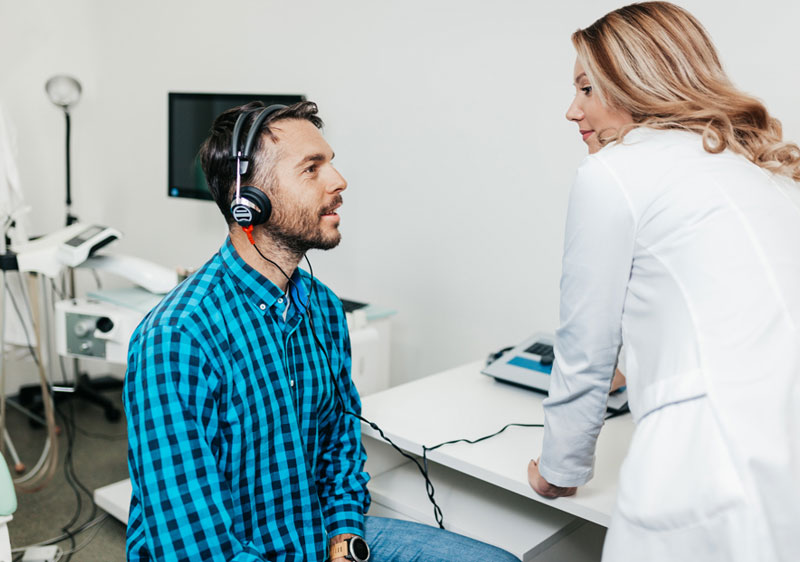
Pure tone audiometry is a diagnostic test used to evaluate a person's hearing sensitivity across various frequencies. It is the most common and fundamental test conducted to assess hearing loss. The test measures the softest sounds a person can hear at different frequencies or pitches.
During a pure tone audiometry test, the individual sits in a soundproof booth and wears headphones or inserts earphones. The audiologist presents a series of tones at different frequencies and intensities to each ear separately. The person's task is to indicate when they hear the tones by pressing a button or raising their hand.
The results of the test are plotted on an audiogram, a graph that shows the individual's hearing thresholds at different frequencies. The thresholds are measured in decibels (dB), with lower dB values indicating better hearing sensitivity. The audiogram provides information about the type, degree, and configuration of hearing loss, if present.
The audiologist may test different frequencies ranging from low to high, typically from 250 Hz to 8000 Hz. This helps identify the specific frequencies at which the person's hearing may be impaired.
The test results can classify hearing loss into different categories:
- Normal hearing: Hearing thresholds within the normal range (usually 0-25 dB) at all frequencies tested.
- Conductive hearing loss: Higher thresholds at low to mid frequencies indicate a problem in the outer or middle ear, such as earwax buildup, ear infections, or issues with the middle ear bones.
- Sensorineural hearing loss: Elevated thresholds across all or most frequencies suggest a problem in the inner ear or auditory nerve. This can be caused by factors like noise exposure, aging (presbycusis), genetic conditions, or certain medications.
- Mixed hearing loss: A combination of conductive and sensorineural hearing loss is observed when there are abnormalities in both the outer/middle ear and the inner ear or auditory nerve.
Pure tone audiometry provides critical information for diagnosing and managing hearing loss. It helps determine the type and severity of the hearing loss, guides treatment options, and assists in the fitting and programming of hearing aids or cochlear implants.
It's important to have pure tone audiometry conducted by a qualified audiologist or hearing healthcare professional for accurate results and appropriate management of hearing-related conditions.